The Cheap Website Illusion: Calculating True TCO
Sajjad Askari
6 min read
E-Commerce Development
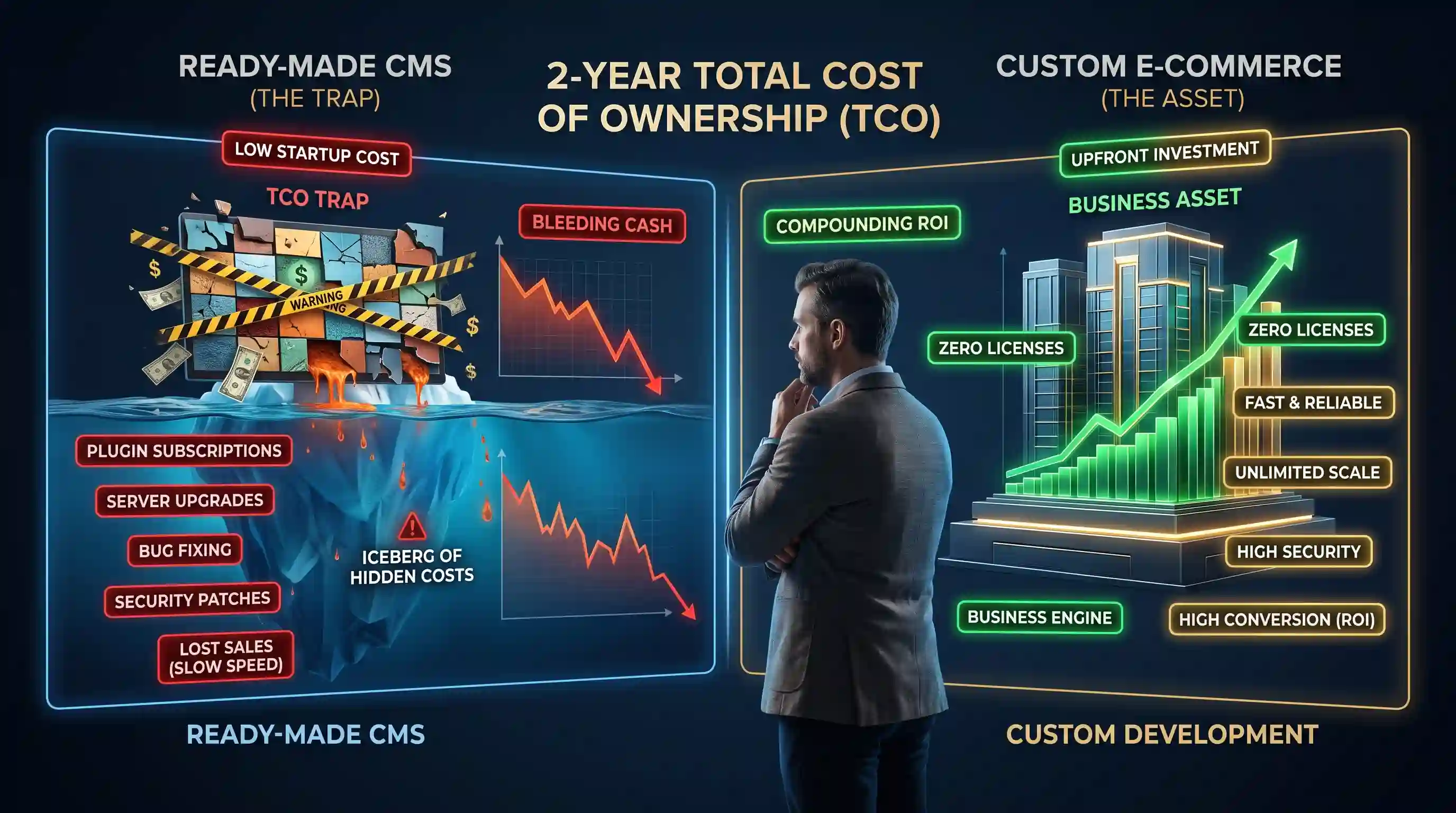
When business owners decide to launch or revamp their online store, the first major dilemma they encounter is choosing between "off-the-shelf content management systems (such as WordPress and WooCommerce)" and "custom e-commerce development." At first glance, the figures on paper seem heavily stacked in favor of ready-made platforms: significantly lower initial expenses and deployment within days on one side, versus a higher upfront investment for engineering and custom code on the other. But why do over 70% of scaling businesses, after one to two years of running on off-the-shelf systems, end up frustrated and forced into a complete rebuild and migration to a custom architecture? The answer lies in a fundamental principle of software engineering economics: Total Cost of Ownership (TCO). In this article, we strip away the marketing hype to dissect the true, bottom-line costs of an e-commerce platform over a 2-year lifecycle using cold mathematical logic and business realities.
The Pricing Illusion: Upfront Setup Cost vs. Total Cost of Ownership (TCO)
Many executives look exclusively at the initial upfront cost when estimating digital budgets. This is identical to purchasing an unusually cheap used car that drags you to the repair shop every single week starting from month two, while burning three times more fuel than a modern vehicle. In software engineering, Total Cost of Ownership (TCO) encompasses five primary cost drivers:
- Initial Design & Implementation: The upfront capital expenditure required to launch on day one.
- Infrastructure, Server & Compute Resources: Recurring monthly and annual bills for hosting, compute instances, and cloud bandwidth.
- Software Licenses, Plugins & Feature Extensions: Ongoing expenses paid to acquire new features or renew third-party plugin and theme licenses.
- Maintenance, Bug Fixing & Security: Developer retainers and hourly rates to resolve code conflicts, patch security vulnerabilities, and handle updates.
- Opportunity Cost: Direct revenue lost due to sluggish load times, checkout friction, and degraded conversion rates.
If you judge platforms solely by the first criterion, off-the-shelf systems win effortlessly. But looking beneath the waterline reveals the hidden portion of the iceberg—where five compounding costs begin devouring your company budget starting around month three.
1. The Subscription Trap: Plugin Hell and Compounding Maintenance
Ready-made platforms are architected generically to cater to the lowest common denominator—from personal blogs to simple digital storefronts. Out of the box, an off-the-shelf CMS cannot satisfy even the basic marketing and transactional requirements of an ambitious commerce brand. To introduce advanced product filtering, seamless checkout flows, dynamic coupon systems, SMS gateways, and performance caching, you inevitably end up bolting on 15 to 25 commercial plugins. Beyond the mounting annual license renewal fees, each extension is authored by an independent vendor. Incompatibilities between third-party codebases remain the number-one reason sites break after routine updates, forcing recurring, expensive emergency support tickets.
Our Engineering Approach: Clean, unified, and modular development built with React and TypeScript. Every capability is engineered specifically around your unique business operations within a single, cohesive codebase. As a direct result, annual licensing overhead drops to zero, bloated external dependencies are eliminated, and your company retains 100% intellectual property ownership of the source code.
2. Bloated Infrastructure Invoices to Offset Inefficient Code
In monolithic legacy architectures, rendering a single product detail page can trigger upwards of 100 simultaneous database queries alongside thousands of lines of unneeded server-side code execution. The consequences manifest immediately when traffic climbs: standard hosting tiers quickly buckle. Because refactoring the core CMS is impossible, business owners are forced to throw expensive hardware at unoptimized software—continuously upgrading server RAM and CPU cores just to keep the website responsive, incurring cloud bills far out of proportion to real business value.
Our Engineering Approach: Harnessing cutting-edge Next.js architecture, granular edge caching, and Incremental Static Regeneration (SSG / ISR). Under this model, catalog pages render in milliseconds while placing minimal burden on backend servers and databases. A lean, cost-efficient server setup can comfortably absorb traffic spikes that would take down legacy platforms.
3. The Hidden Tax on Paid Ads: Conversion Leaks
Consider deploying significant marketing budgets each month across Google Ads, paid social, or influencer channels to drive prospective customers to your store. According to industry-wide benchmarks, every 1-second delay in mobile load times slashes conversion rates by up to 20%. Off-the-shelf templates, weighed down by dozens of uncompressed scripts and obsolete render pipelines, routinely fail Google's Core Web Vitals. Losing even 15% of your purchase-ready traffic to sluggish interfaces or checkout lag is essentially throwing thousands of ad dollars directly down the drain.
Our Engineering Approach: Engineering frictionless user journeys via Server-Side Rendering (SSR) in Next.js paired with utility-first styling in Tailwind CSS. We reduce page transitions and cart interactions to sub-second speeds, unlocking maximum Return on Ad Spend (ROAS) and securing top search engine visibility through flawless technical SEO scores.
4. Emergency Interventions, Security Hazards & Vulnerability Patches
"The store is completely down," "The payment gateway broke after the latest update," "The layout is completely distorted on mobile screens." These are familiar nightmares for owners of off-the-shelf systems. Because generic CMS codebases and widely used extensions are globally accessible open-source targets, finding exploit vectors in unmaintained plugins is trivial for attackers. The ad-hoc retainers and emergency consulting fees paid to technical agencies to clean malware, fix database corruptions, or patch vulnerabilities rapidly add up to staggering sums by year-end.
Our Engineering Approach: Strictly decoupling the presentation layer (front-end) from data processing and persistence (back-end). By authoring proprietary code without unvetted third-party plugins, the platform's attack surface shrinks dramatically, guaranteeing corporate-grade security, enterprise stability, and uninterrupted operations without constant emergency interventions.
5. The Glass Ceiling of Scalability (The Inevitable Rebuild Cost)
The most damaging financial blow arrives precisely when your company gains real momentum. The moment you require real-time inventory synchronization with your accounting or ERP software, need a customized CRM setup, or prepare a high-velocity flash sale with thousands of concurrent shoppers, the monolithic boundaries of ready-made platforms collapse. At this inflection point, all capital invested in nursing the template system over the prior two years is written off as a sunken cost, leaving you no choice but to start over from scratch with a custom platform.
Our Engineering Approach: Architecting a decoupled Headless Architecture with high-throughput backend services powered by NestJS and robust relational data layers like PostgreSQL. This foundation enables you to integrate any warehouse management system, accounting engine, or AI-powered assistant via secure APIs at any time—without rewriting existing code.
Comparison Matrix: Real Total Cost of Ownership (TCO) Over 24 Months
To bring clarity to the conversation, the table below maps out the practical operational and capital expenditures of running an active mid-to-high-tier e-commerce business over a 2-year horizon across both paradigms:
| Cost Vector | Ready-Made CMS (Traditional / Monolithic) | Custom Architecture (Modern / Next.js) |
|---|---|---|
| Initial Upfront Investment | Low (deceptively attractive at launch) | Moderate to High (single upfront engineering investment) |
| Plugin & Theme Renewals | Recurring and compounding (15–25 paid licenses yearly) | Zero (perpetual, 100% proprietary code ownership) |
| High-Traffic Infrastructure Costs | High (requires heavy cloud tiers to offset unoptimized code) | Lean & predictable (minimal hardware consumption at edge) |
| Maintenance & Issue Resolution | High & unpredictable after routine version upgrades | Minimal (rock-solid stability of a unified architecture) |
| Custom Feature Engineering | Prohibitive and restricted by core platform constraints | Agile, frictionless, and architecturally unbounded |
| Opportunity Loss from Latency | Substantial (continuous leakage of ad acquisition spend) | Virtually zero (sub-second speeds and optimal conversion rates) |
| Asset Value at End of Year 2 | Depreciated, bloated legacy system ready for scrap | A scalable, proprietary digital software asset |
When Does a Ready-Made CMS Make Sense vs. Custom Development?
The objective of this breakdown is not to dismiss off-the-shelf platforms altogether; each tool fits a specific maturity phase. Making the right architectural call depends directly on your operational scale:
- An off-the-shelf CMS is the right pick if: You are testing an unvalidated concept with minimal budget (early MVP), generating fewer than a few dozen visits a day, spending zero budget on performance advertising, and operating standard catalog workflows with no need for third-party integrations.
- A custom architecture becomes non-negotiable if: Your business has cleared the experimental stage, you invest in paid customer acquisition and technical SEO, mobile user experience and brand credibility are core differentiators, you require dependable integrations with ERP and inventory systems, and you need infrastructure built to scale seamlessly over multiple years without requiring structural demolition.
Conclusion: Are You Incurring Expenses or Building an Asset?
The core difference between an off-the-shelf website and a custom-engineered e-commerce platform is the exact difference between renting a prefabricated temporary cabin versus building a commercial headquarters on engineered foundations. The prefab cabin is cheaper and faster on day one, but it trembles in the first severe storm and cannot support additional floors as operations expand. If you view your online storefront not merely as a digital business card, but as the primary revenue engine of your business, committing to rigorous engineering from the start is the smartest financial decision to eliminate hidden, compounding overhead. To assess your current platform or discuss architecting an enterprise-grade custom store tailored to your operations, feel free to reach out via my contact form so we can map out the optimal technological path for your scale.