1 The Ready-Made Bottleneck: Confronting Code Bloat
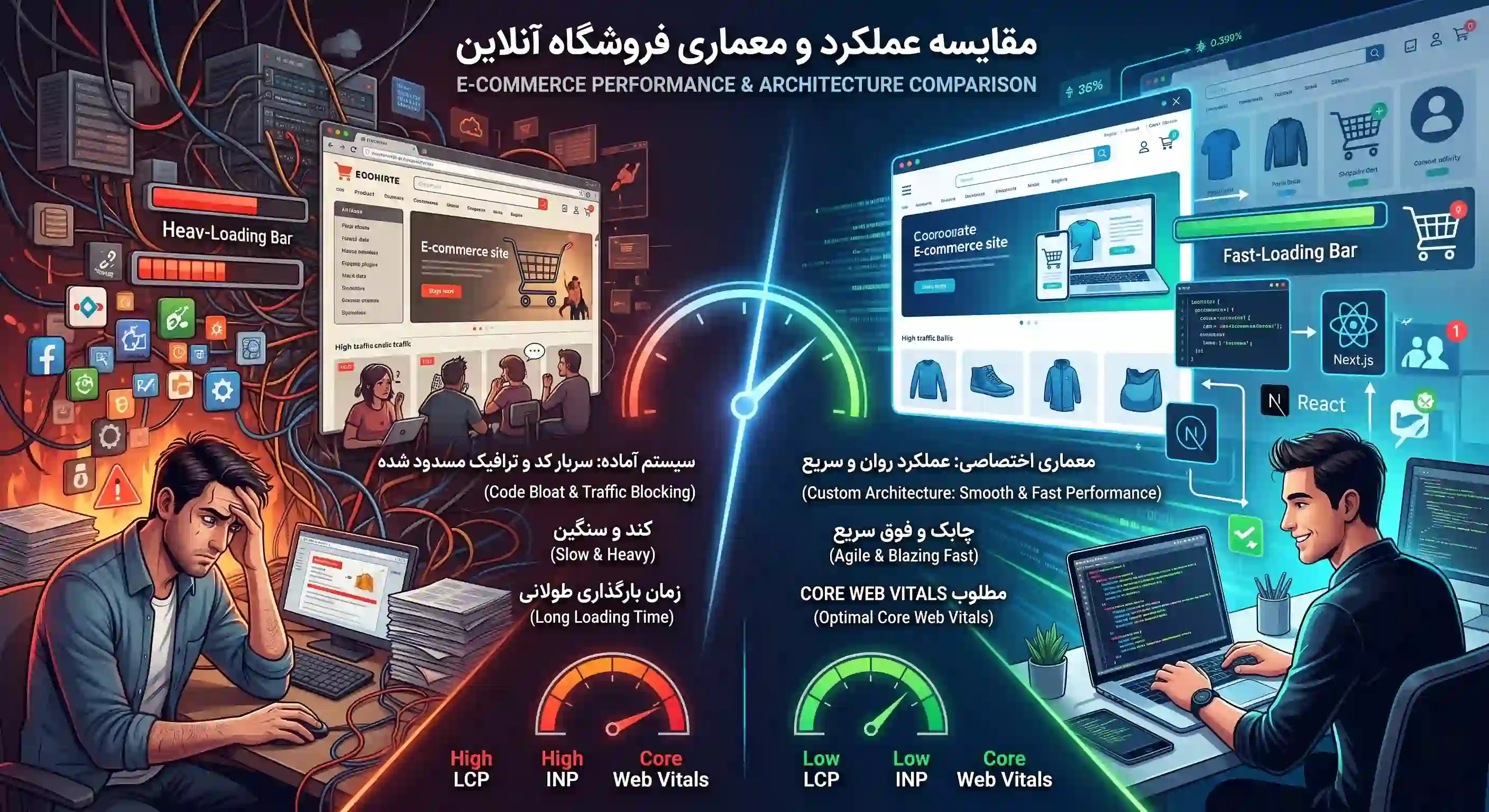
Template-driven systems (like WordPress) are designed to cover the generic needs of thousands of different businesses. This "jack-of-all-trades" nature comes at a heavy performance cost. The user's browser is forced to download and process massive CSS files and JavaScript libraries, of which only a tiny fraction might actually be used on the current page.
Template-Based CMS (WordPress)
Loading unused code, heavy reliance on third-party plugins, main thread blocking, and severe speed degradation at scale.
Custom Website Architecture
Smart code splitting, precise control over bundle sizes, clean architecture, and total elimination of unnecessary dependencies.
When code is written line-by-line exactly for a business's specific needs, not a single extra byte travels across the network. This is the first step toward a lightning-fast e-commerce site.
2 Managing Core Concerns: Modern Rendering vs. Legacy Processing
One of the biggest shared concerns between employers and developers is maintaining page load speeds as product catalogs and user traffic grow. In legacy systems, with every user request, the server must query the database and construct the HTML page from scratch. This process quickly degrades under heavy traffic.
The solution to this challenge is migrating toward front-end development with modern frameworks. Utilizing Server-Side Rendering (SSR) and Static Site Generation (SSG) means pages are pre-built or rendered at the Edge, delivered to the user in a fraction of a second.
3 Golden Performance Metrics Unattainable by Templates
Modern search engine algorithms are highly sensitive to user experience. Achieving top scores in Core Web Vitals requires meticulous engineering:
- Reducing LCP (Largest Contentful Paint): In a custom site, loading hero images and primary text is optimized without interference from render-blocking scripts, utilizing modern image formats.
- Rapid Responsiveness or INP (Interaction to Next Paint): Custom JavaScript architecture prevents the browser from freezing during product filtering or add-to-cart actions, delivering a flawlessly smooth interaction.
- Visual Stability (CLS): By precisely reserving space for images and custom fonts within the codebase, annoying layout shifts during page load are reduced to zero.
4 Mastering Front-End Architecture: Decoupling for Infinite Speed
Today, the front-end and back-end should no longer be trapped within a single monolithic system. In professional e-commerce development, we utilize Headless architecture. The front-end layer is developed using powerful frameworks like Next.js and deployed on blazing-fast cloud infrastructures (such as Vercel).
This separation empowers the front-end developer to focus entirely on UI optimization, smart caching, and real-time interactions, while the backend independently handles business logic and databases. The result is a website that never buckles under the immense traffic of sales campaigns.
5 The Performance Engineering Path for Front-End Developers
- Deep mastery of various rendering strategies in both browser and server (CSR, SSR, SSG, ISR).
- Learning advanced techniques in Code Splitting, Lazy Loading, and complex State management.
- Optimizing static assets (images, fonts) and implementing Edge-layer caching.
- Total decoupling of front-end logic from the backend to design flexible, scalable systems.
✓ Conclusion: Investing in the Technological Core
Developing a custom-coded e-commerce website is not merely paying for programming; it is an investment in the beating heart of the business. By moving past ready-made platforms and embracing modern front-end architecture, you not only create an unparalleled user experience but also guarantee robust SEO and absolute stability during peak traffic days. In today's competitive market, performance crowns the ultimate winner.